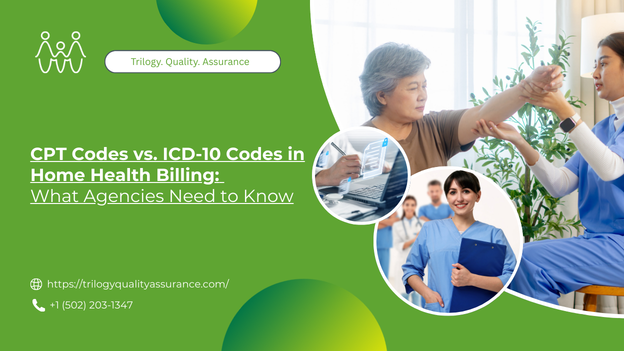
Accurate billing in home health care depends on more than just documentation—it requires a clear understanding of coding systems. One of the most common areas of confusion for agencies is the difference between CPT codes for home health and ICD-10 diagnosis codes.
While both are essential for Medicare billing, they serve entirely different purposes. Misunderstanding how these codes work together can lead to claim denials, compliance issues, and lost revenue.
This guide explains the difference between CPT and ICD-10 codes, how they apply to home health billing, and what agencies need to do to ensure accuracy and compliance.
CPT (Current Procedural Terminology) codes are used to describe the services provided to a patient. These codes are maintained by the American Medical Association (AMA) and are widely used across healthcare billing systems.
In home health care, CPT codes may be used to represent:
Skilled nursing services
Therapy visits (physical, occupational, speech)
Evaluation and management services
Specific medical procedures performed during visits
For example, agencies often search for:
CPT code for home health services
CPT code for home health care skilled nursing
What is the CPT code for home health visits
It’s important to note that traditional Medicare home health billing (under PPS) does not always rely heavily on CPT codes for reimbursement. However, CPT codes are still relevant in:
Therapy documentation
Certain billing scenarios
Supplemental reporting and compliance
ICD-10 codes describe the patient’s diagnosis or medical condition. These codes justify why home health services are medically necessary.
In home health care, ICD-10 codes:
Define the patient’s primary condition
Support eligibility for skilled services
Influence case-mix grouping and reimbursement
Align with OASIS and physician documentation
For example:
I10 – Hypertension
E11.9 – Type 2 diabetes
J44.9 – COPD
Unlike CPT codes, ICD-10 codes are directly tied to medical necessity and reimbursement eligibility.
Understanding ICD-10 vs CPT is critical for accurate home health billing.
| ICD-10 Codes | CPT Codes |
|---|---|
| Describe the patient’s diagnosis | Describe the service provided |
| Justify medical necessity | Document procedures or visits |
| Required for Medicare reimbursement | Used for reporting and billing services |
| Drive case-mix and payment models | Support service-level documentation |
In simple terms:
ICD-10 = Why the patient needs care
CPT = What care was provided
Both must align for claims to be processed correctly.
In home health billing, CPT and ICD-10 codes are not used independently—they must work together.
Here’s how:
The ICD-10 code establishes the patient’s diagnosis
The CPT code reflects the service provided
Documentation connects both to justify skilled care
For example:
A patient diagnosed with COPD (ICD-10: J44.9)
Receives respiratory assessment and skilled nursing care
CPT codes document the services provided during visits
If the diagnosis does not support the service billed, the claim may be denied.
Many agencies search for clarity around CPT codes in home health care. Here are some important points:
No. There is no single universal CPT code for all home health services. Codes vary depending on the type of service provided.
Skilled nursing services are often documented through broader billing systems under Medicare home health PPS rather than a single CPT code. However, CPT codes may still be used in certain contexts for documentation and reporting.
Not directly in all cases. Medicare home health reimbursement primarily depends on diagnosis coding, OASIS data, and case-mix grouping. However, CPT codes still support documentation accuracy and compliance.
Confusion between ICD-10 and CPT codes often leads to avoidable errors, including:
Mismatch between diagnosis and service provided
Incorrect or missing CPT codes in documentation
Over-reliance on generic or unspecified ICD-10 codes
Inconsistent documentation across clinical records
Failure to align coding with OASIS assessments
These issues can result in denied claims, delayed payments, or compliance risks.
Accurate coding is essential for:
Clean claim submission
Reduced denial rates
Audit readiness
Proper reimbursement
Regulatory compliance
Even small inconsistencies between CPT and ICD-10 codes can trigger reviews or require rework.
At Trilogy Quality Assurance, we help home health agencies improve coding accuracy by aligning diagnosis coding, service documentation, and compliance processes.
Our team supports agencies with:
ICD-10 coding validation
Documentation audits
Compliance reviews
Coding accuracy improvement strategies
By ensuring that CPT and ICD-10 codes work together effectively, we help agencies reduce errors, improve billing outcomes, and stay compliant with CMS guidelines.
Also Check: ICD-10 Codes for Home Health Care – Complete 2026 Guide
Understanding the difference between CPT and ICD-10 codes is essential for accurate home health billing. While ICD-10 codes define the patient’s condition, CPT codes describe the care provided. Both must align with documentation to support medical necessity and reimbursement.
By improving coding practices and maintaining strong documentation standards, home health agencies can reduce errors, avoid compliance risks, and improve financial performance.
Partnering with experienced experts like Trilogy Quality Assurance ensures your agency stays accurate, compliant, and audit-ready.
There is no single CPT code for all home health services. CPT codes vary based on the type of service provided, such as skilled nursing, therapy, or evaluations.
ICD-10 codes describe the patient’s diagnosis, while CPT codes describe the services provided. Both are required for accurate billing and documentation.
CPT codes support documentation and service reporting, but Medicare reimbursement in home health is primarily driven by ICD-10 codes and case-mix grouping.
Yes. If CPT and ICD-10 codes do not align with documentation, claims may be denied or delayed.
Accurate coding ensures proper reimbursement, reduces audit risk, and maintains compliance with CMS guidelines.
Health care is a vital aspect of maintaining overall well-being, encompassing a range of services from preventive care
(502) 203-1347